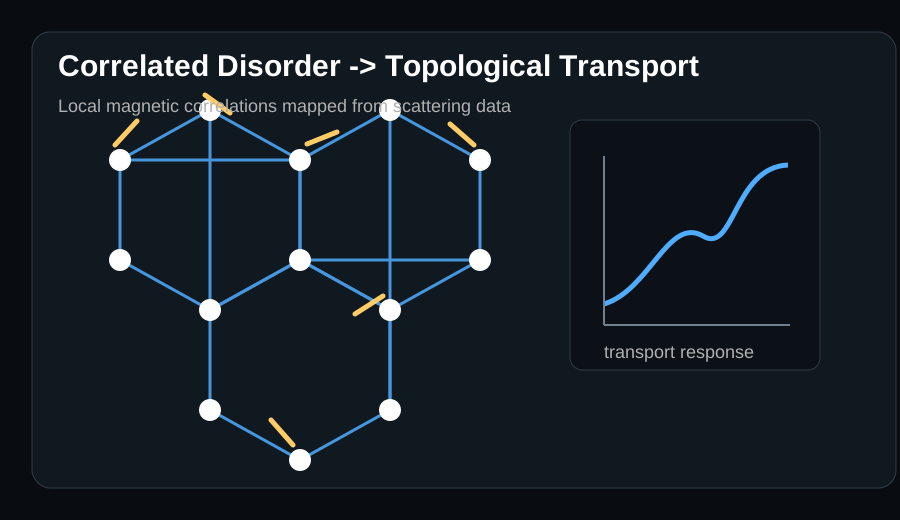
Hidden in Plain Sight: How Magnetism Breaks Local Symmetry in Kagome Metals
Kagome-lattice metals like CoSn and FeSn are compelling because their corner-sharing triangular geometry can host flat bands, strong correlations, and topological electronic states.
Much of our understanding of these materials starts from the average crystal structure: the long-range, periodic arrangement of atoms seen by conventional diffraction. In our recent Journal of the American Chemical Society paper, we showed that this average picture can miss important local distortions that emerge together with magnetism.
Key finding: In $(Co_{0.45}Fe_{0.55})Sn$, antiferromagnetic order and local symmetry breaking develop together, revealing a hidden spin-lattice coupling in the kagome metal.
1. The “Average” Picture: Hexagonal and Magnetic
Using neutron diffraction, we first examined the long-range magnetic order. Below the Neel temperature ($T_N \approx 140$ K), the material develops A-type antiferromagnetic order.
In this state, the magnetic moments on the kagome layers align ferromagnetically within each plane but stack antiferromagnetically along the c-axis.
Figure 1: The average crystal structure and magnetic order.
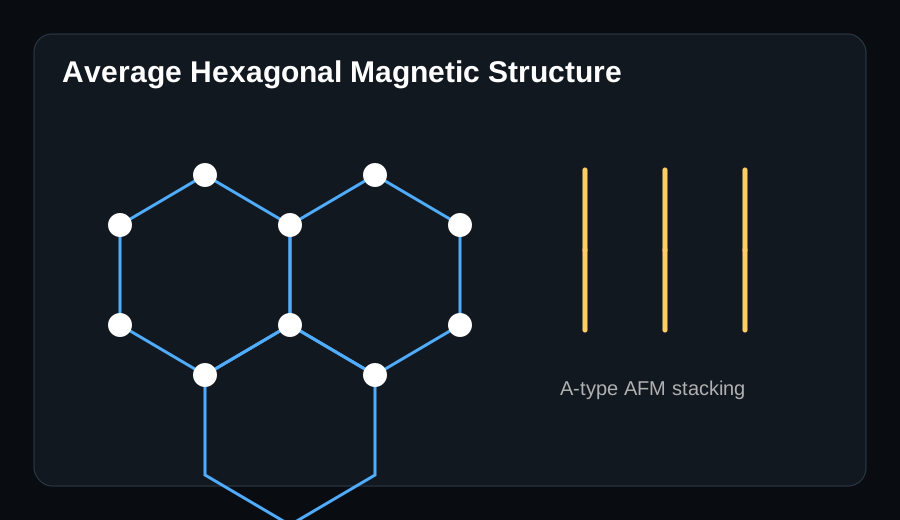
Globally, the crystal structure appears to remain stable in its hexagonal $P6/mmm$ symmetry. If we only looked at standard diffraction, we would conclude that the lattice stays hexagonal down to low temperature.
2. The “Local” Picture: Hidden Orthorhombic Distortion
To see what was happening at the atomic scale, we used synchrotron X-ray pair distribution function (PDF) analysis and Reverse Monte Carlo (RMC) modeling. Unlike standard diffraction, PDF analysis is sensitive to local deviations from the average structure.
We found that below $T_N$, the local symmetry breaks from hexagonal to orthorhombic ($Cmmm$).
This distortion is subtle. Long-range diffraction averages it out, but locally it signals a lattice instability that turns on when magnetic order sets in.
3. The Mechanism: Sn(2) Atoms on the Move
What drives this local symmetry breaking? Our analysis points to the Sn(2) atoms located in the honeycomb layers between the magnetic kagome planes.
RMC modeling suggests that these Sn(2) atoms shift off-axis, creating locally varied bond lengths and angles between the magnetic metal ions and Sn(2) atoms.
Figure 2: Local distortion motif showing the displacement of Sn(2) atoms.
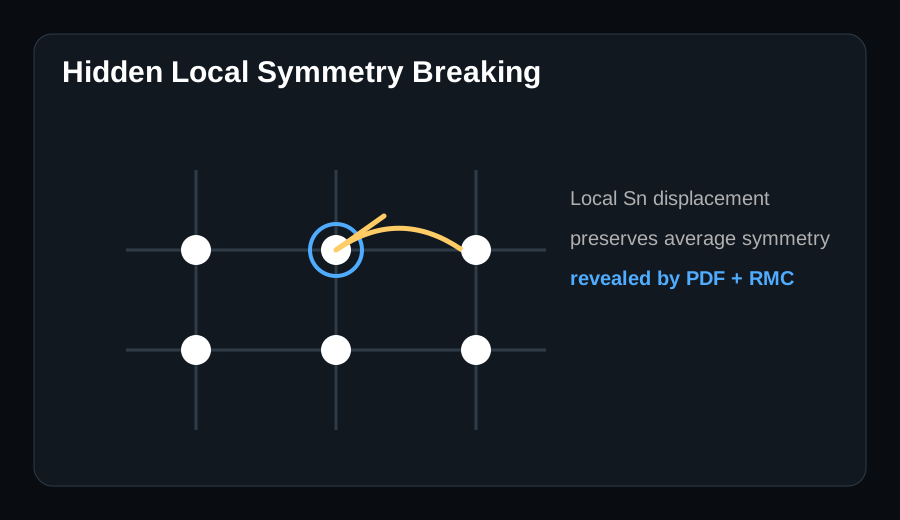
We argue that this structural distortion has a magnetic origin. The out-of-plane magnetic exchange interaction ($J_c$), which couples the magnetic layers through the $M-Sn(2)-M$ pathway, likely helps drive these local displacements and stabilize the AFM ground state.
Why This Matters
This study highlights a strong, previously overlooked coupling between spin and lattice degrees of freedom in kagome metals.
Theoretical calculations often assume a perfect hexagonal lattice. Local orthorhombic distortions could change the electronic band structure, including the flat-band physics that makes kagome materials so interesting.
By combining neutron diffraction for average order with total scattering for local structure, we can reveal hidden complexity that standard techniques might miss.
For more details, read our full paper: Simultaneous Development of Antiferromagnetism and Local Symmetry Breaking in a Kagome Magnet (Co0.45Fe0.55)Sn.