<?xml version="1.0" encoding="utf-8"?><feed xmlns="http://www.w3.org/2005/Atom" ><generator uri="https://jekyllrb.com/" version="3.10.0">Jekyll</generator><link href="https://drthyang.github.io/feed.xml" rel="self" type="application/atom+xml" /><link href="https://drthyang.github.io/" rel="alternate" type="text/html" /><updated>2026-07-02T20:13:11+00:00</updated><id>https://drthyang.github.io/feed.xml</id><title type="html">Tsung-Han Yang</title><subtitle>Postdoctoral Researcher at ORNL | Quantum Materials | Advanced Characterization &amp; Modeling</subtitle><author><name>Tsung-Han Yang</name></author><entry><title type="html">Hidden in Plain Sight: How Magnetism Breaks Local Symmetry in Kagome Metals</title><link href="https://drthyang.github.io/research/condensed%20matter/2026/02/16/CoSn/" rel="alternate" type="text/html" title="Hidden in Plain Sight: How Magnetism Breaks Local Symmetry in Kagome Metals" /><published>2026-02-16T00:00:00+00:00</published><updated>2026-02-16T00:00:00+00:00</updated><id>https://drthyang.github.io/research/condensed%20matter/2026/02/16/CoSn</id><content type="html" xml:base="https://drthyang.github.io/research/condensed%20matter/2026/02/16/CoSn/"><![CDATA[<p><strong>Kagome-lattice metals</strong> like CoSn and FeSn are compelling because their corner-sharing triangular geometry can host flat bands, strong correlations, and topological electronic states.</p>

<p>Much of our understanding of these materials starts from the <strong>average crystal structure</strong>: the long-range, periodic arrangement of atoms seen by conventional diffraction. In our recent <em>Journal of the American Chemical Society</em> paper, we showed that this average picture can miss important local distortions that emerge together with magnetism.</p>

<blockquote>
  <p><strong>Key finding:</strong> In $(Co_{0.45}Fe_{0.55})Sn$, antiferromagnetic order and local symmetry breaking develop together, revealing a hidden spin-lattice coupling in the kagome metal.</p>
</blockquote>

<h2 id="1-the-average-picture-hexagonal-and-magnetic">1. The “Average” Picture: Hexagonal and Magnetic</h2>

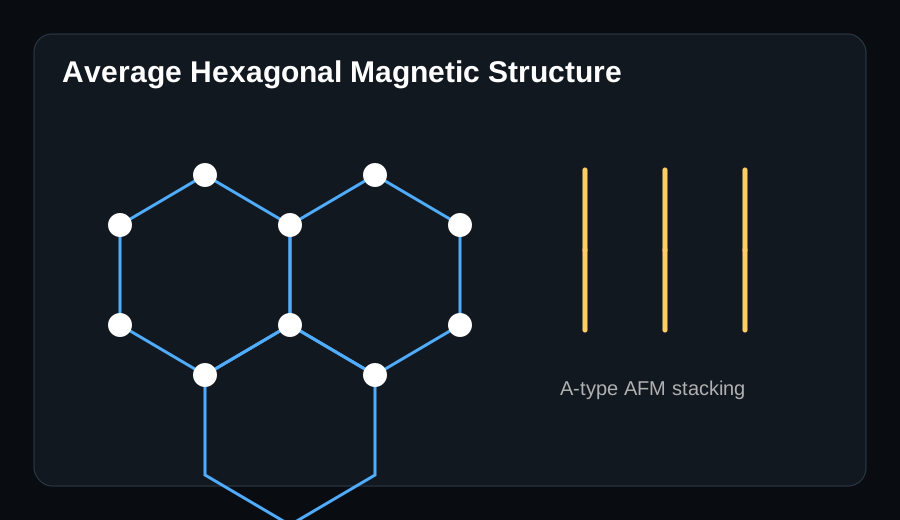
<p>Using <strong>neutron diffraction</strong>, we first examined the long-range magnetic order. Below the Neel temperature ($T_N \approx 140$ K), the material develops <strong>A-type antiferromagnetic order</strong>.</p>

<p>In this state, the magnetic moments on the kagome layers align ferromagnetically within each plane but stack antiferromagnetically along the <em>c</em>-axis.</p>

<p><strong>Figure 1:</strong> <em>The average crystal structure and magnetic order.</em>
<img src="/assets/images/kagome-average-structure.svg" alt="Average Structure" /></p>

<p>Globally, the crystal structure appears to remain stable in its hexagonal <strong>$P6/mmm$</strong> symmetry. If we only looked at standard diffraction, we would conclude that the lattice stays hexagonal down to low temperature.</p>

<h2 id="2-the-local-picture-hidden-orthorhombic-distortion">2. The “Local” Picture: Hidden Orthorhombic Distortion</h2>

<p>To see what was happening at the atomic scale, we used <strong>synchrotron X-ray pair distribution function (PDF)</strong> analysis and <strong>Reverse Monte Carlo (RMC)</strong> modeling. Unlike standard diffraction, PDF analysis is sensitive to local deviations from the average structure.</p>

<p>We found that below $T_N$, the <em>local</em> symmetry breaks from hexagonal to <strong>orthorhombic ($Cmmm$)</strong>.</p>

<p>This distortion is subtle. Long-range diffraction averages it out, but locally it signals a lattice instability that turns on when magnetic order sets in.</p>

<h2 id="3-the-mechanism-sn2-atoms-on-the-move">3. The Mechanism: Sn(2) Atoms on the Move</h2>

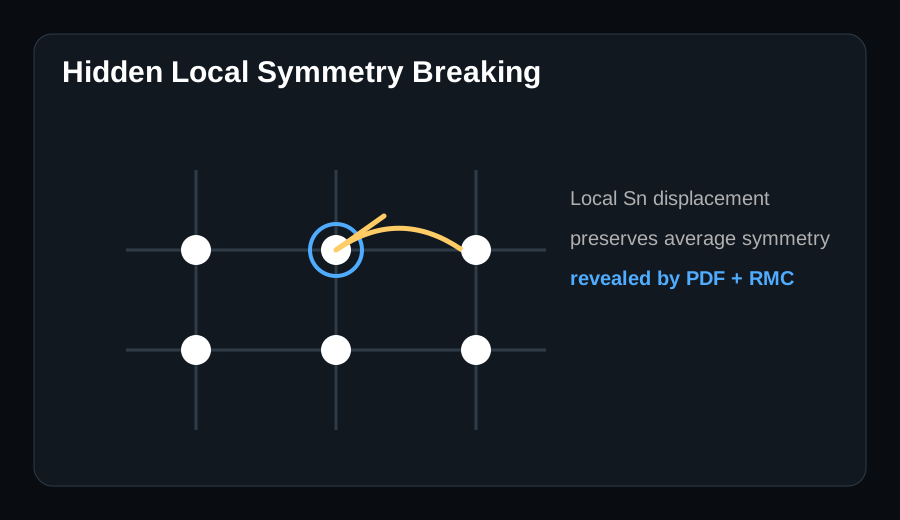
<p>What drives this local symmetry breaking? Our analysis points to the <strong>Sn(2) atoms</strong> located in the honeycomb layers between the magnetic kagome planes.</p>

<p>RMC modeling suggests that these Sn(2) atoms shift off-axis, creating locally varied bond lengths and angles between the magnetic metal ions and Sn(2) atoms.</p>

<p><strong>Figure 2:</strong> <em>Local distortion motif showing the displacement of Sn(2) atoms.</em>
<img src="/assets/images/local-distortion.svg" alt="Local Distortion" /></p>

<p>We argue that this structural distortion has a <strong>magnetic origin</strong>. The out-of-plane magnetic exchange interaction ($J_c$), which couples the magnetic layers through the $M-Sn(2)-M$ pathway, likely helps drive these local displacements and stabilize the AFM ground state.</p>

<h2 id="why-this-matters">Why This Matters</h2>

<p>This study highlights a strong, previously overlooked coupling between <strong>spin and lattice degrees of freedom</strong> in kagome metals.</p>

<p>Theoretical calculations often assume a perfect hexagonal lattice. Local orthorhombic distortions could change the electronic band structure, including the flat-band physics that makes kagome materials so interesting.</p>

<p>By combining neutron diffraction for average order with total scattering for local structure, we can reveal hidden complexity that standard techniques might miss.</p>

<hr />
<p><em>For more details, read our full paper: <a href="https://doi.org/10.1021/jacs.4c09387">Simultaneous Development of Antiferromagnetism and Local Symmetry Breaking in a Kagome Magnet (Co0.45Fe0.55)Sn</a>.</em></p>]]></content><author><name>Tsung-Han Yang</name></author><category term="Research" /><category term="Condensed Matter" /><category term="Kagome Lattice" /><category term="Neutron Diffraction" /><category term="PDF Analysis" /><category term="Magnetism" /><summary type="html"><![CDATA[We discovered a hidden local symmetry breaking in the Kagome magnet (Co,Fe)Sn that co-emerges with antiferromagnetism, challenging the standard understanding of these topological materials.]]></summary></entry><entry><title type="html">Topology and Disorder, Friends or Foes?</title><link href="https://drthyang.github.io/quantum%20materials/materials%20science/2026/02/16/mn3sn/" rel="alternate" type="text/html" title="Topology and Disorder, Friends or Foes?" /><published>2026-02-16T00:00:00+00:00</published><updated>2026-02-16T00:00:00+00:00</updated><id>https://drthyang.github.io/quantum%20materials/materials%20science/2026/02/16/mn3sn</id><content type="html" xml:base="https://drthyang.github.io/quantum%20materials/materials%20science/2026/02/16/mn3sn/"><![CDATA[<h2 id="introduction">Introduction</h2>
<p>Topological properties often depend on symmetry, magnetic texture, and spin-orbit coupling. That can make disorder sound like a threat: if local structure or local magnetism deviates from the ideal model, will the topological response disappear?</p>

<p>In real quantum materials, the answer is more interesting. Disorder is not always random damage. Short-range correlations, local distortions, and domain textures can become part of the mechanism that controls transport.</p>

<h2 id="disorder-as-information">Disorder as Information</h2>

<p>For materials such as Mn<sub>3</sub>Sn, the anomalous Hall effect is usually discussed through the lens of long-range magnetic symmetry and Berry curvature. But neutron total scattering and local modeling let us ask a complementary question:</p>

<blockquote>
  <p>What local magnetic correlations are present before they become visible as long-range order?</p>
</blockquote>

<p>That question matters because local correlations can influence how a material approaches a topological transition, how robust its transport response is, and how much of the observed behavior is controlled by nanoscale texture rather than only the average crystal structure.</p>

<h2 id="computational-angle">Computational Angle</h2>

<p>This is where the problem becomes a data-science problem as much as a physics problem. Total-scattering experiments produce information-rich but indirect measurements. Extracting meaning requires inverse modeling, constrained optimization, uncertainty checks, and careful comparison between simulated and observed signals.</p>

<p>The workflow is close in spirit to many industrial modeling problems:</p>

<ul>
  <li>the signal is noisy and indirect,</li>
  <li>the model is high-dimensional,</li>
  <li>the interpretation depends on domain constraints,</li>
  <li>and the result needs to be communicated clearly enough to guide decisions.</li>
</ul>

<h2 id="takeaway">Takeaway</h2>

<p>Disorder and topology are not automatically enemies. In correlated quantum materials, local disorder can be a hidden design variable. The technical challenge is building tools that can detect, model, and validate that hidden structure.</p>

<h2 id="references">References</h2>

<ul>
  <li>Selected related papers are listed on the <a href="/publications/">publications page</a>.</li>
</ul>]]></content><author><name>Tsung-Han Yang</name></author><category term="Quantum Materials" /><category term="Materials Science" /><category term="topology" /><category term="quantum" /><summary type="html"><![CDATA[A short note on why disorder can be a design variable rather than only a defect in topological magnetic materials.]]></summary></entry></feed>