My research connects two things usually done by different people: a decade of hands-on quantum-materials experiments and AI systems that assist the expert judgment those experiments require. Every claim below is grounded in instruments I have operated and analysis loops I have run by hand — before teaching an agent to help.
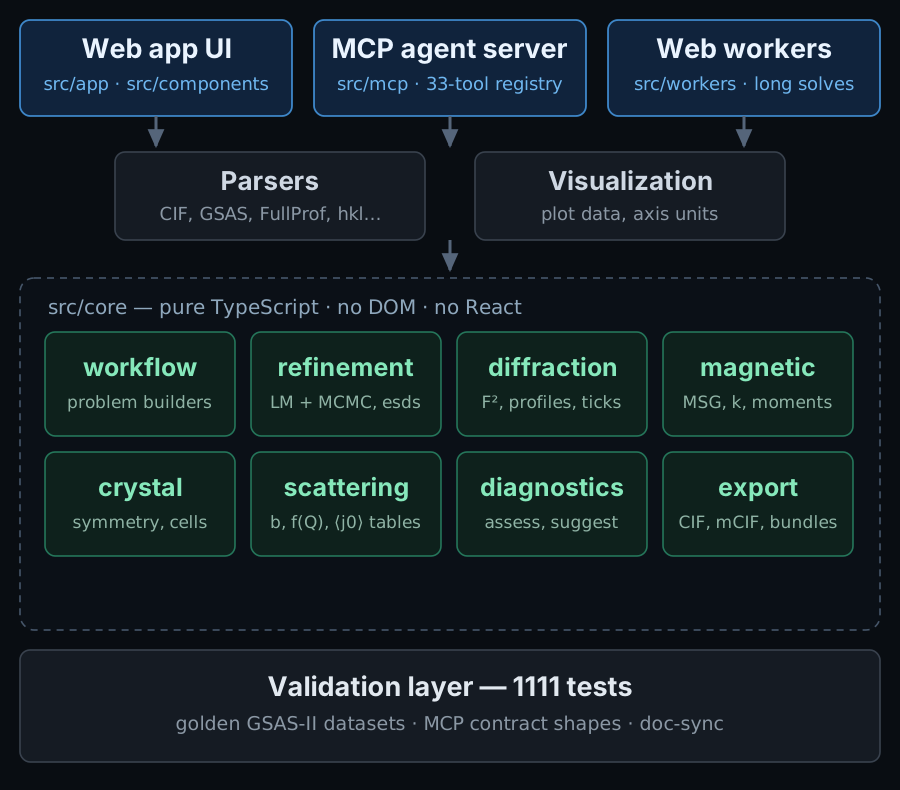
The expert loop in scattering analysis — freeing parameters, judging residuals, grading a reduction, watching convergence — never got automated. I study how much of it LLM agents can help with when given real domain tools instead of chat: MATERIA exposes a refinement engine to agents as MCP tools, NEBULA3D has an LLM grade reduction quality, RMCProfile Workbench reasons over live runs, and Athanor benchmarks agent-driven screening against non-LLM baselines. All of it is independent, personal open-source work.
Grounding principles: physics-based tools the agent must call, uncertainty it can quantify, local-first models, evaluation against baselines — not demos.
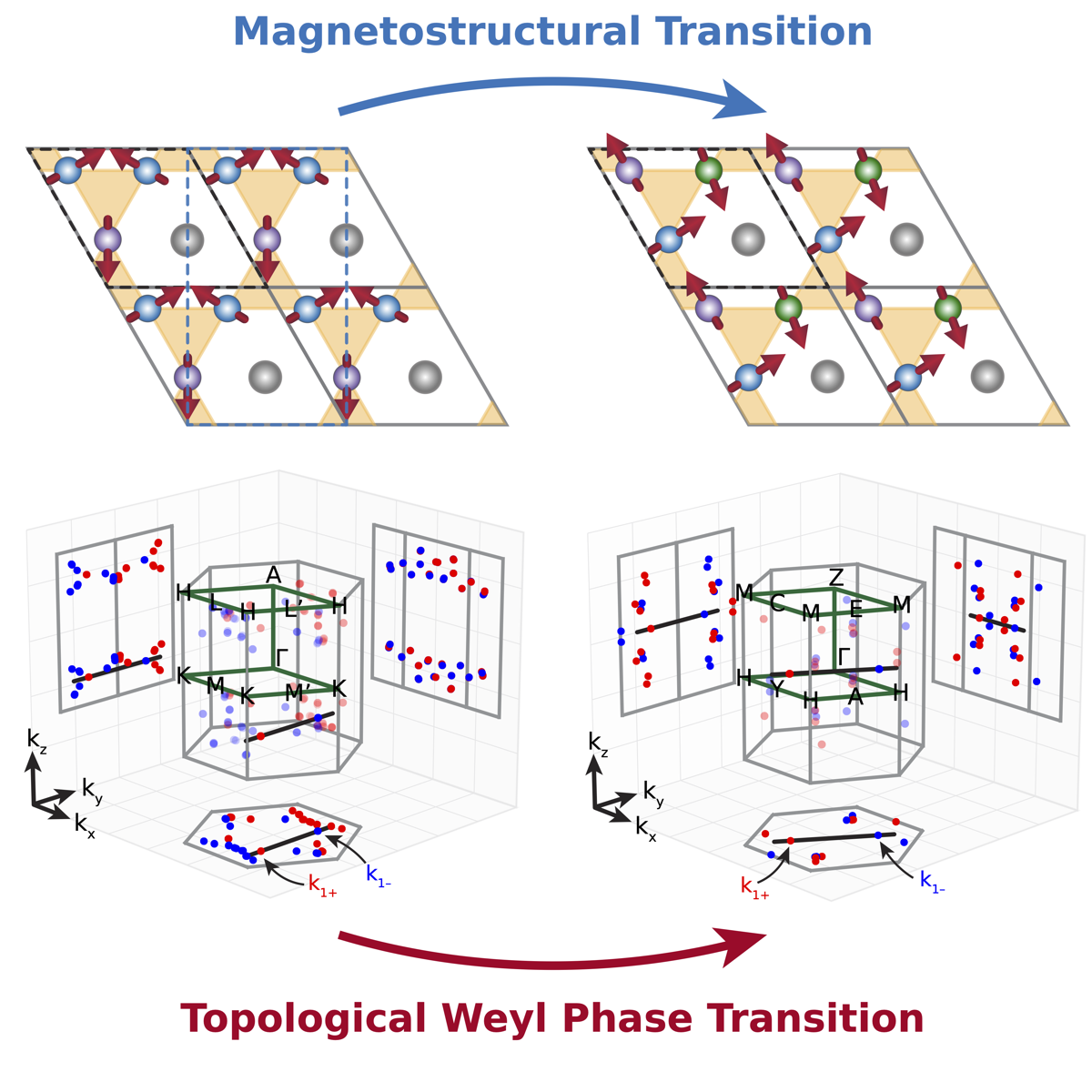
Kagome magnets host Weyl nodes and anomalous transport that the lattice can in principle switch — if you find a material where the switch operates. My first-author Nature Communications (2026) study of Mn3Ga found exactly that: an intrinsic topological Weyl phase transition driven by a magnetostructural transformation near room temperature.
Why it matters: a room-temperature, lattice-coupled route to switching topological states — the mechanism antiferromagnetic spintronics needs.
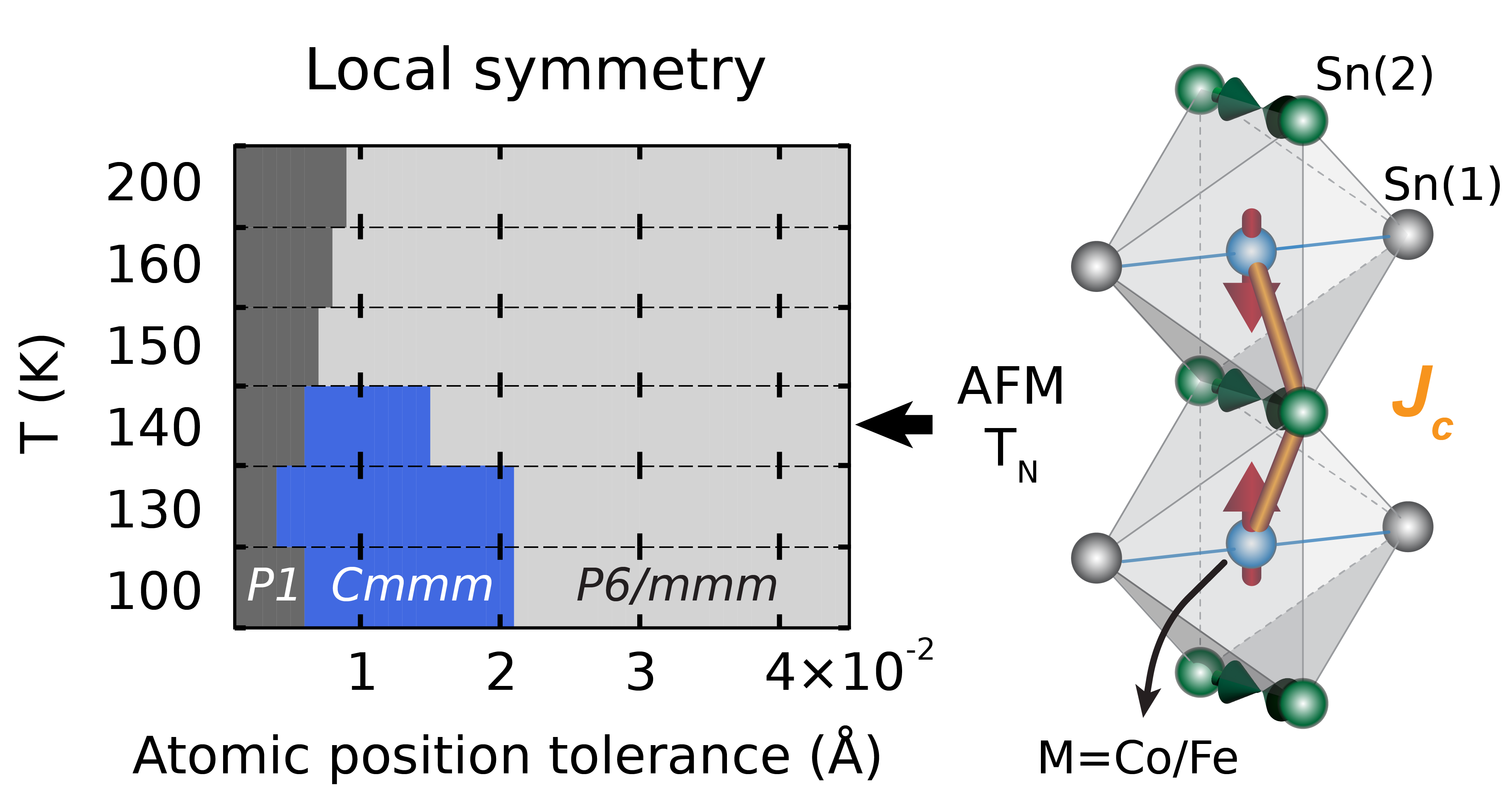
Average structures hide the physics. Using PDF, diffuse scattering, and large-box RMC modeling, I resolve what conventional crystallography misses: local symmetry breaking emerging with antiferromagnetic order in kagome (Fe,Co)Sn (JACS 2024), quadrupolar ordering and spin-orbital dimers in GaNb4Se8 (PRB 2024), and bond ordering in the cluster Mott insulator GaTa4Se8 (PRR 2022).
The thread: disorder is not noise — quantifying it is what turns a structure into a mechanism.
RMC ensembles encode experimentally constrained disorder — but only as static snapshots. I extract dynamics from them: phonon bands, DOS, and simulated INS computed directly from ensembles, ~100× faster with WebGPU, plus 3D-ΔPDF pipelines where every cleanup decision is inspectable. Everything ships as browser tools — your own data, nothing to install.
Outcome: measured total scattering to phonon spectra, no separate simulation backend — published as working, open-source software.
I have owned every step of the pipeline. Synthesis: flux and vapor-transport crystals, inert-atmosphere chemistry, MBE thin films. Measurement: neutron and synchrotron experiments designed and run at ORNL's Spallation Neutron Source and other national facilities, plus STM/SP-STM down to single molecules — under cryogenic, high-pressure, and UHV conditions.
Why it matters for AI: knowing where data comes from — and how it breaks — separates physics-grounded models from black boxes.