Phonon Dynamics in Disordered Systems
View on GitHub
Methodology:
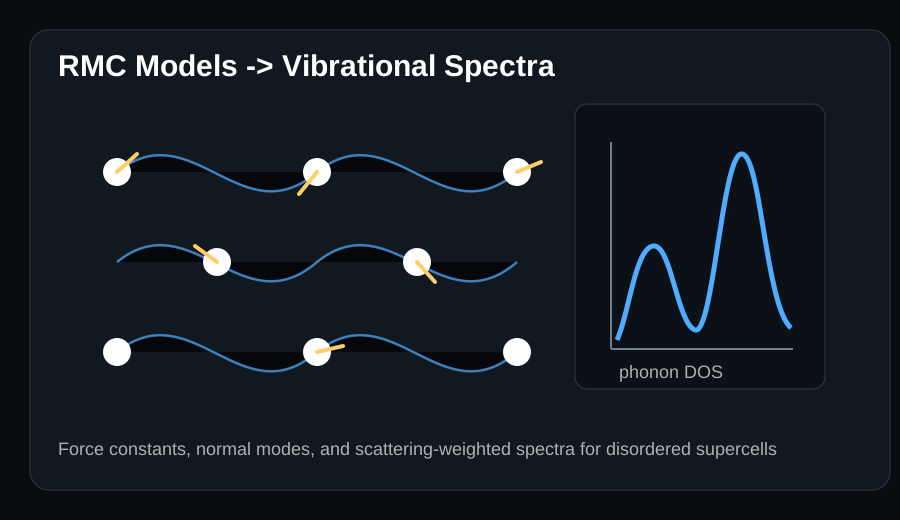
Developed a high-performance numerical engine to calculate vibrational properties from Reverse Monte Carlo (RMC) structural models.
Algorithm:
Implemented Force Constant Matrix (Hessian) construction for large-scale disordered supercells, using finite-displacement methods, sparse numerical workflows, and Python/C++ kernels.
Challenge:
Optimized the computation of the Dynamic Structure Factor $S(Q, \omega)$ by parallelizing the Fourier transform of atomic trajectories across $10^5+$ coordinates.
Impact:
Enables direct comparison between theoretical atomic models and experimental Inelastic Neutron Scattering (INS) data for non-crystalline materials.
Materials Data & Scattering Workflows
Research
Overview:
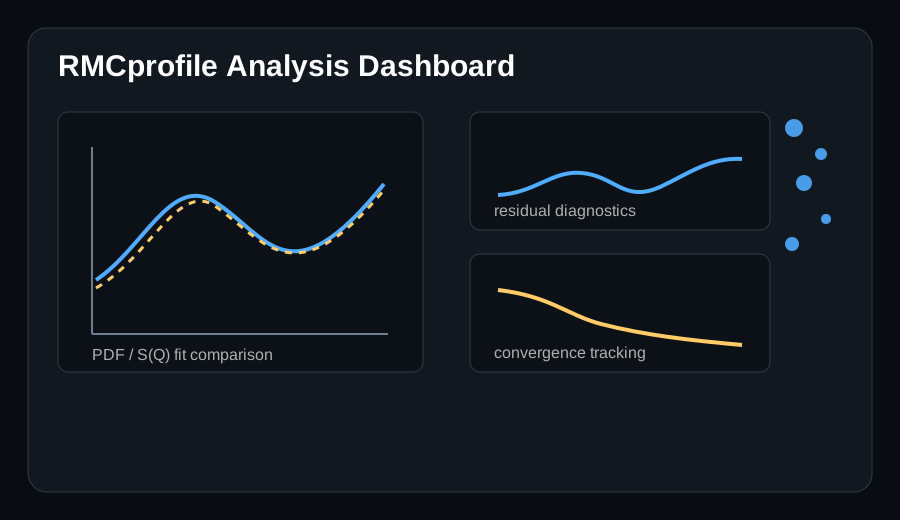
A learning and project track for building reproducible Python workflows around neutron scattering, PDF analysis, and atomistic model validation.
Features:
Includes fit diagnostics, model-comparison plots, local-structure summaries, and reusable Python analysis patterns for scattering-informed materials research.
Physics-Informed Neural Networks
Related Notes
Overview:
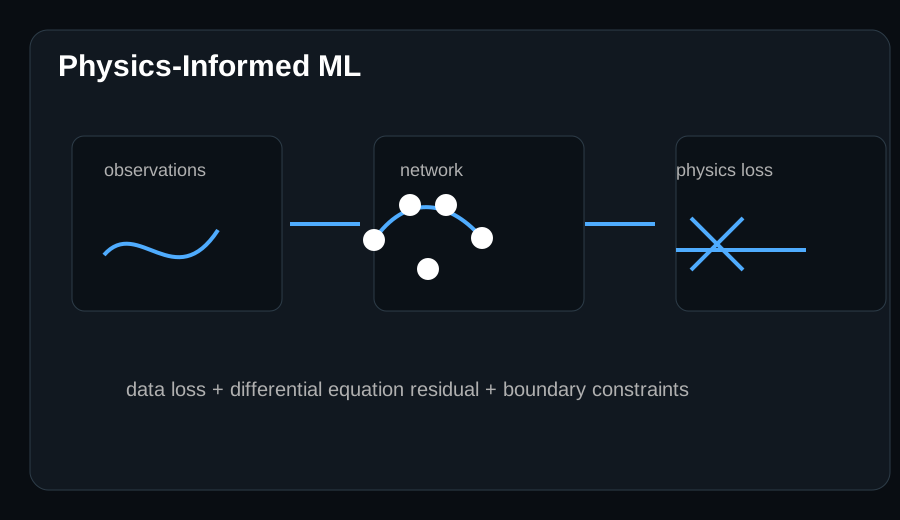
A learning track for solving differential-equation and inverse-problem examples with neural networks constrained by physical residuals.
Focus:
Connects scientific modeling habits with modern ML: loss design, parameter inference, uncertainty checks, and physically meaningful validation.